 SEO is a marketing strategy for increasing relevance of a given site. It involves optimizing web pages with purpose to make them more search-engine-friendly. Desired result is to get higher position in search result through which increased site traffic is generated.
This process improves the volume of traffic from search engines via ‘natural’ search (as opposed to sponsored) results for targeted keywords. Many unique elements, including internal and external aspects of the website are targeted and optimized to achieve a desired goal; it is a combination of design, user-friendliness and content.
SEO is the more technical part of Web marketing and requires some technical knowledge. SEO is not all that simple, and it is usually handled by professional firms specializing in SEO. Areas of SEO range from discovery of terms and phrases and making a site search-engine friendly, to building the links.
Customers and competition
Search engines can be one of the easiest way your customers and potential customers can find your company. The online environment is becoming increasingly competitive and if one’s site cannot be found by the search engine, the opportunities available to websites are missed. Indeed the ultimate goal is to get better ranking and beat the competition - and increase your own business traffic.
How search engines work

Search engines are text-driven. This means they can’t read sounds, movies, images, Flash etc. Search engines run so-called ‘spiders’, automated programs that ‘crawl' the pages through links, to get an idea what the site is about. Spiders index everything they find on their way, which involves storing the information in a database of documents ("index") from which it can be later retrieved. This process identifies the words that best describe the page and assign the page to particular keywords. Since likely there is thousands of pages found, the engine’s algorithm runs calculations on the results to determine relevancy of a given page. Each search engine’s algorithm has different relative weights of factors (such as keyword density, links and meta-tags) - this explains why different engines give different results for the same query. Last step is retrieving the results, in a form of displaying them in the browser, sorted from the most relevant to the least relevant.
Must-do's of SEO
- Keyword research - Research your competition, target audience, industry and trends, and find out what people are actually looking for. These keywords then have to be embedded in your website, both on and off page. Using the most appropriate keywords and expressions describing your site is a key.
- Good content – As search engines are text driven, the text is very important. The site has to have a lot of ‘reading material’ that can be ‘crawled’ and indexed. Search engines seek the keywords and rank the site accordingly.
- Links - Search engines view links like voting system. If you have a lot of sites that link to yours, this increases your ranking in the search results. The more links the better, but it is crucial that these links link using the targeted keyword. Another aspect to consider is the quality of links – if the links come from very popular and important (and thus, trustworthy) websites, they have multiplier effect.
- Title tags and meta tags – these are the behind-the-scenes pieces of text that, too, help search engine read and understand what your site is about. Title tag appears in a web browser in the title bar and provides a clue to the content of the website. They are seen as hyperlinks in the search results. Needles to say title tags are ‘crawled’ and help rank the site and it is vital that title tags contain your desired keyword. Meta tags is data in the HTML header providing information that is not visible in browsers and contain keywords and descriptions of the web-page, enabling one’s site to be catalogued.
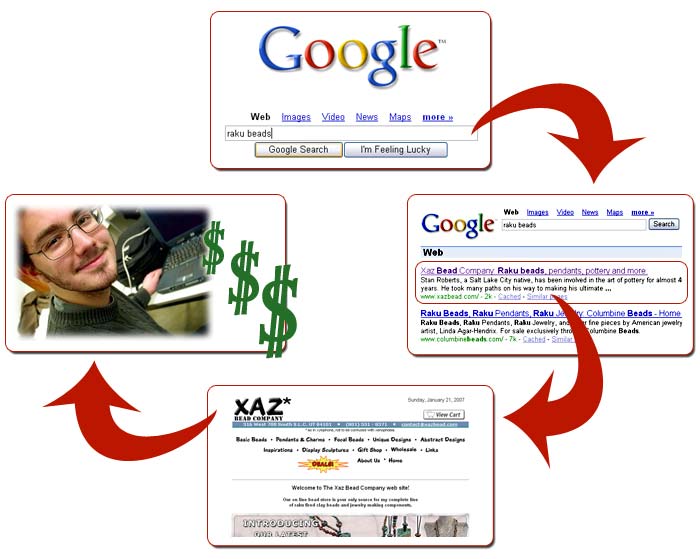
Things to watch out for
As engine’s spiders crawl the web they rely on structure of hyperlinks to find new documents. Complex links and deep site structures may hinder the success. Incapability of data access is a barrier to successful SEO.
Another concern is spamdexing, which is intended to manipulate the relevancy of one’s site to increase the chance of a website being placed higher in the results. This is done through excessive keyword-repeating to increase the keyword density by using hidden or tiny text. In fact, artificially stuffed meta-tags and keyword-heavy pages can get your site penalized and may be dropped from searches completely. As high quality links can boost your ranking, the low quality, interlinked sites or automated domains (aka link farms) will discount the value of your site. Thus, know the linked websites.
Finally...
Search engine ranking changes frequently due to competition and new sites. Therefore, maintaining a top ranking calls for constant keyword monitoring, site result monitoring and information revision. SEO is not exclusive of the past – it never sleeps, just like your competitors.- http://www.website-development-training.com/learn-seo/
- http://www.webconfs.com/
- http://www.seoconsultants.com/seo/tips/
Sources:
- Best SEO Practices - 4 Informative SEO Facts [http://ezinearticles.com/?Best-SEO-Practices----4-Informative-SEO-Facts&id=892292]
- What is SEO [http://www.webconfs.com/seo-tutorial/introduction-to-seo.php]
- What is Good Search Engine Optimizing? [http://www.jigsawinc.com/goodseo.html]
- Beginner's Guide - How Search Engines Operate [http://www.seomoz.org/article/bg2]
- Network Solutions Sr VP; Beginner Tips for SEO [http://video.google.com/videoplay?docid=2291196768936987539]
Sources 1-4 retrieved February 26 ,2008; Source 5 retrieved February 24.

1 comment:
You are give me SEO - Search Engine Optimization related information that is more informatic for me and i also need to share with you my topic:
SEO Firm India, for more information please visit:-
http://www.wildnettechnologies.com/seo-company-india/seo-firm.htm
Post a Comment